What is ICT Turtle Soup Trading
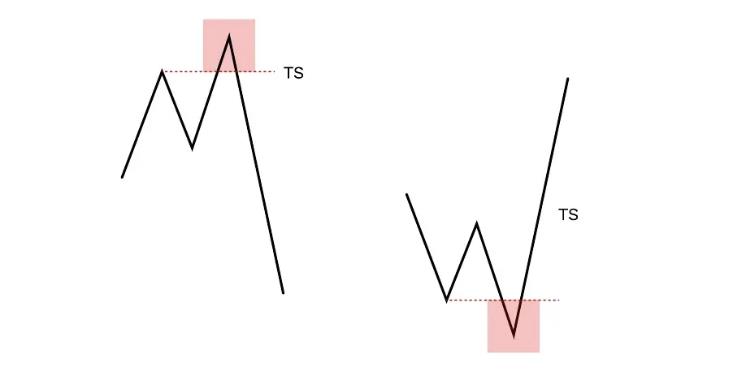
Indeed, ICT Turtle Soup Trading (TS) refers to a fake breakout, commonly known as a stop hunt or raid on stops. Turtle Soup simply means Liquidity Sweep.
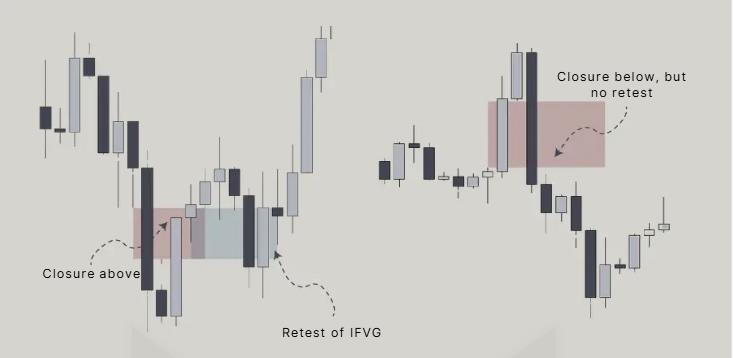
When a Fair Value Gap (FVG) is not respected (confirmed by a candle closure above or below), it transforms into an Inverse Fair Value Gap (IFVG)! Similar to the flip between Support & Resistance, when a support level is invalidated, it flips to act as resistance.
This holds true for Order Blocks, which transform into Breaker Blocks, just as Supply zones switch to Demand zones and vice versa when breached. In simpler terms, when any of these levels or zones are disregarded, they typically shift from bullish to bearish, or vice versa.
Our focus will center on understanding this transition between bullish and bearish trends using the Fair Value Gap (FVG) & Inverse Fair Value Gap (IFVG)!
Closing above/below a Fair Value Gap (FVG) is the primary factor to classify it as an Inverse Fair Value Gap (IFVG), but its subsequent behavior could vary. Here are some possible scenarios to consider:
Yes! This ICT Trading Strategy revolves around the Inverse Fair Value Gap (IFVG).
However, we won’t be executing trades for every Inverse Fair Value Gap (IFVG) we encounter. Instead, we’ll concentrate solely on Inverse Fair Value Gaps (IFVGs) generated after price hits specific levels, within specific time slots.
As mentioned earlier, we won’t trade any Inverse Fair Value Gap (IFVG), but only high probability ones. We’ll primarily focus on two main variants:
1. Price being rejected from a Fair Value Gap (FVG) (alternatively, an Order Block or POI). As price approaches the Fair Value Gap (FVG), it should form a single Fair Value Gap (FVG). The crucial aspect here is the violation of this singular Fair Value Gap (FVG) with a body closure after the initial rejection from the first Fair Value Gap (FVG).
2. Price Liquidity Sweep Level. Similar to the first scenario, as price heads towards this liquidity level, it should create a single FVG. The key is the violation of this singular Fair Value Gap (FVG) with a body closure after the sweep, followed by the price returning into the range (Power of 3).
Beyond these primary variants, there are numerous other scenarios with additional confluences that fall under these two main setups. This specific framework will provide us with high probability setups!
There are various ways to enter after the violation of the Fair Value Gap (confirmed by a candle closure above/below it), and the choice of entry method is personal. Each entry criterion comes with its own set of pros and cons.
This is the most basic entry criteria. Simply when a candle closes below/above the Fair Value Gap (FVG), the Inverse Fair Value Gap (IFVG) is created and we can enter with the body closure.
Pros: No missing trades.
Cons: Not the best price to enter, lower reward to risk, fake out sometimes (not a closure on HTF).
After the violation (candle closure), we wait for price to retrace back into the beginning of the IFVG.
Pros: Better reward to risk, better entry.
Cons: It is possible to miss trades as price sometimes does not retrace.
After the violation (candle closure), we wait for price to retrace back not into the beginning of the Inverse Fair Value Gap (IFVG), but to 50% of it!
Pros: Better reward to risk, better entry.
Cons: It is possible to miss trades as price sometimes does not retrace back to 50% of the Inverse Fair Value Gap (IFVG).
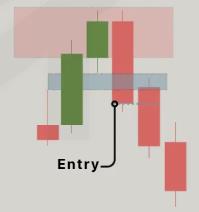
This is a very high probability entry. We are looking for price to violate the FVG with a Fair Value Gap (FVG). Entry can be at:
Pros: Very high probability entry, better entry & reward to risk.
Cons: Missing trades.
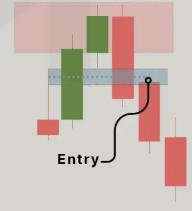
All entry types are effective! You simply need to adapt to one based on an understanding of its pros and cons, finding the approach that aligns with your personality, account, and risk management. You’ll delve deeper into this in the next chapter.
When it comes to the stop loss placement, there are different approaches to follow.
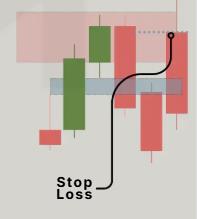
Stop loss is placed above/below the recent swing high/low.
Pros: The safest level to place a stop loss.
Cons: Lower reward to risk.
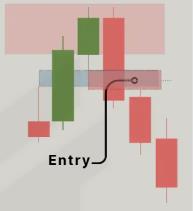
No fixed stop loss prior to entering the trade, but it will depend on the closure above/below the Inverse Fair Value Gap (IFVG). If that Inverse Fair Value Gap (IFVG) we entered from is violated, then we exit immediately. It will be more of a manual SL.
Pros: Higher reward to risk.
Cons: Price could close above then reverse.
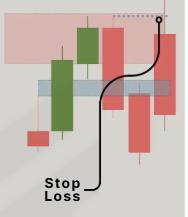
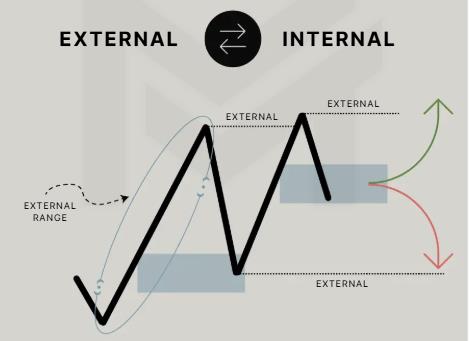
To decide where to take profit, it’s crucial to comprehend the market movement you’re engaged in. Ask yourself whether the price is moving from external to internal or vice versa. Observe where the price is reaching and its intended direction. Another simple approach is to aim for low-hanging fruit (nearest high/low) or the nearest major Fair Value Gap (FVG).
Free. No signals, no recommendations.
 by
by